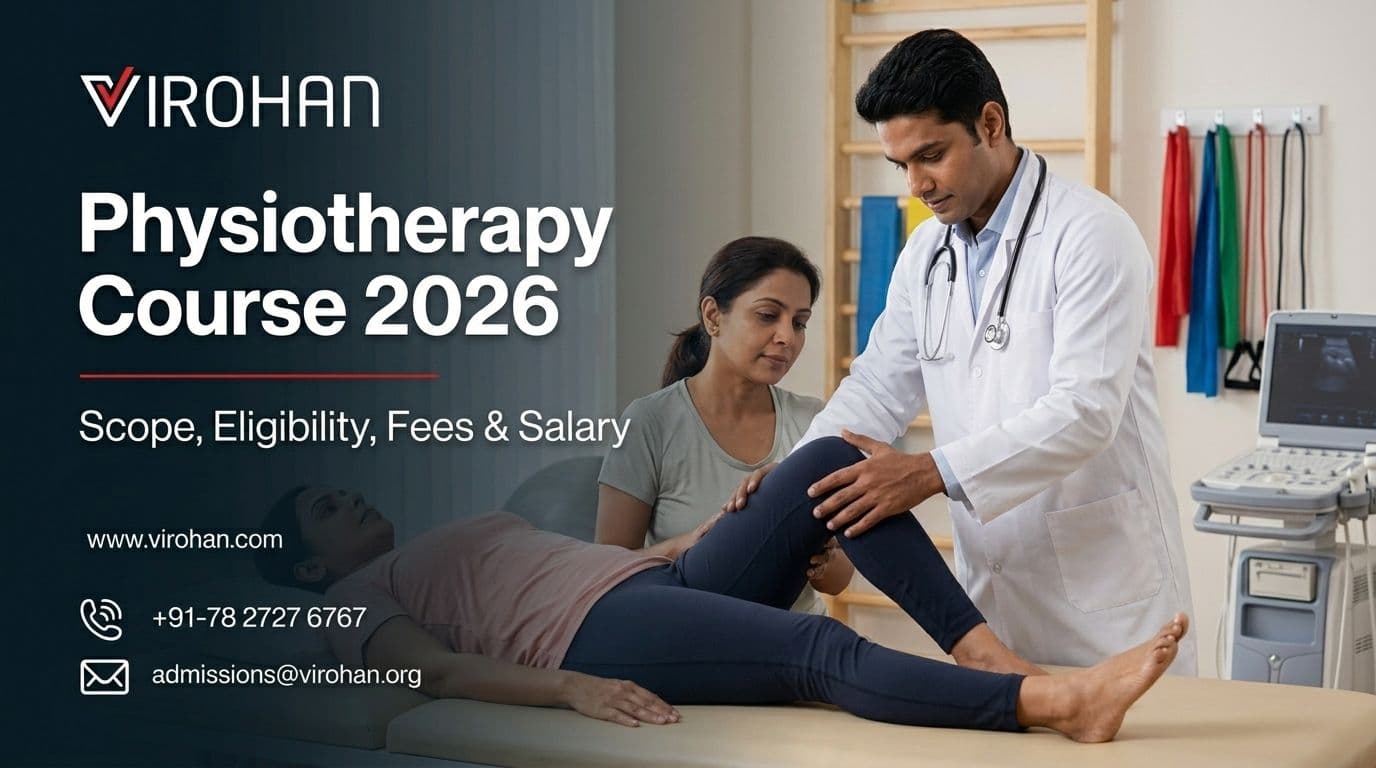
The main physiotherapy course in India is the Bachelor of Physiotherapy (BPT), a 5-year degree that includes a 1-year internship. To apply, you need 12th pass with 40% in all subjects individually, English mandatory and a minimum 50% in PCB, and NEET is not required for AY 2026-27. Physiotherapists in India earn an average of ₹3.4 LPA (AmbitionBox, September 2026), and you can study BPT at universities partnering with Virohan such as Vikrant University, Gwalior and SR University, Warangal.
This guide sets out the course details in the order most students check them: eligibility, duration, fees, year-wise subjects, salary, jobs and where to study.
Physiotherapy Course Details at a Glance
| Field | Details |
|---|
| Course Name | Bachelor of Physiotherapy (BPT) |
| Course Level | Undergraduate degree |
| Course Duration | 5 years: 4 academic years + 1-year internship |
| Admission Process | Merit-based on 12th marks; some universities run their own entrance test. NEET not required for AY 2026-27 |
| Course Eligibility | 12th pass with 40% in all subjects individually; English mandatory; minimum 50% in PCB; minimum age 17 |
| Course Fees | ₹12,40,000 total program fee at Vikrant University, Gwalior, plus ₹10,000 registration; fees differ by university |
| Job Profiles | Physiotherapy Consultant, Rehabilitation Specialist, Orthopedic Physiotherapy, Corporate Wellness Physiotherapy, Ergonomics Specialist |
| Average Annual Salary | Physiotherapist ₹3.4 LPA; Senior Physiotherapist ₹4.9 LPA (AmbitionBox, September 2026) |
What Is Physiotherapy?
Physiotherapy is the healthcare profession that restores and improves movement. A physiotherapist examines how a person moves, finds the cause of pain or limitation, and treats it with exercise therapy, manual therapy and electrotherapy. The work covers recovery after fractures and surgery, stroke rehabilitation, sports injuries, breathing problems after illness, and mobility for children and older adults.
Physiotherapy is regulated by the National Commission for Allied and Healthcare Professions (NCAHP), which notified the national Physiotherapy curriculum on 24 April 2025. BPT is the undergraduate degree built on that curriculum.
Physiotherapy Course Eligibility
| Requirement | What you need for BPT |
|---|
| Subjects in 12th | Physics, Chemistry and Biology, with English as a mandatory subject |
| Marks | 40% in all subjects individually and a minimum 50% in PCB |
| Age | At least 17 by the intake cut-off |
| Entrance | NEET not required for AY 2026-27; some universities run their own test |
NEET for BPT, explained. NCAHP had planned NEET-based admission for BPT. The NCAHP letter dated 02 March 2026 deferred that requirement to AY 2027-28. If you are applying for the 2026-27 intake, admission is on your 12th marks. If you plan to apply a year later, check the rule again before you prepare.
If you studied PCM rather than PCB, BPT is not open to you, but degrees such as B.AOTT and Optometry accept PCM students.
Physiotherapy Course Duration
BPT takes 5 years. The first 4 years are academic study with practical sessions, and the fifth year is a full-time internship in hospital and clinical settings, where you treat patients under supervision across departments such as orthopaedics, neurology and cardiopulmonary care. The internship is part of the degree, so you graduate only after completing it.
After BPT, a 2-year Master of Physiotherapy (MPT) lets you specialize.
Physiotherapy Course Fees
BPT fees are quoted as a total for the full 5-year program. At Vikrant University, Gwalior, the total program fee for 5-year degrees, including BPT, is ₹12,40,000, plus a ₹10,000 registration fee. Fees differ at other universities partnering with Virohan and at government colleges, so check current figures on virohan.com/courses.
When you budget, add hostel or rent, food, travel, books and uniforms for all five years.
Physiotherapy Course Subjects: Year-wise Syllabus
| Year | Main subjects and training |
|---|
| Year 1 | Human anatomy, physiology, biochemistry, basics of psychology and sociology, introduction to physiotherapy |
| Year 2 | Pathology, microbiology, pharmacology, biomechanics and kinesiology, exercise therapy, electrotherapy |
| Year 3 | Orthopaedics, general medicine, general surgery, orthopaedic physiotherapy, clinical assessment |
| Year 4 | Neurological physiotherapy, cardiopulmonary physiotherapy, community-based rehabilitation, sports physiotherapy, research methodology and biostatistics |
| Year 5 | Internship rotations across orthopaedic, neurological, cardiopulmonary, paediatric and community settings |
Practical work runs through every year: joint and muscle assessment, therapeutic exercise, electrotherapy equipment, gait training and treatment documentation.
Physiotherapy Specializations
| Specialization | What you work on |
|---|
| Orthopaedic (musculoskeletal) | Fractures, joint replacements, back and neck pain, ligament injuries |
| Neurological | Stroke, spinal cord injury, Parkinson's disease and balance disorders |
| Sports | Injury prevention, acute sports injuries and return to play |
| Cardiopulmonary | Breathing and fitness after heart or lung illness and surgery |
| Paediatric | Developmental delay, cerebral palsy and childhood mobility |
| Geriatric | Balance, falls prevention and independence in older adults |
| Women's health | Pelvic health and pre- and post-natal care |
You choose a specialization later, usually through an MPT or focused clinical experience. For each area in detail, read our guide to BPT specializations.
Physiotherapist Salary in India
| Role | Average salary | Top 10% earn above | Top 1% earn above | Source |
|---|
| Physiotherapist | ₹3.4 LPA | ₹5 LPA | ₹10.9 LPA | AmbitionBox, September 2026 |
| Senior Physiotherapist | ₹4.9 LPA | ₹7 LPA | ₹12.2 LPA | AmbitionBox, September 2026 |
In monthly terms, ₹3.4 LPA is about ₹28,300 and ₹4.9 LPA is about ₹40,800 before deductions. Pay rises with experience, an MPT specialization and senior or private-practice work. These figures are indicative, not guaranteed.
Jobs After a Physiotherapy Course
Roles on the BPT career path include:
- Physiotherapy Consultant: assesses patients and plans treatment in hospitals and clinics
- Rehabilitation Specialist: supports longer recovery after stroke, injury or surgery
- Orthopedic Physiotherapy: treats bone, joint and muscle conditions
- Corporate Wellness Physiotherapy: runs workplace ergonomics and injury prevention
- Ergonomics Specialist: improves posture and workstation set-up
- Assistive Technology Specialist: helps patients use mobility aids and devices
You can work in hospitals, rehabilitation centers, sports teams and academies, outpatient clinics, home care, elder care and community programs. With experience, you can take on senior clinical roles, teach after further study, or set up your own practice.
Where to Study BPT: Universities with Virohan as Industry Partner
| University | Location |
|---|
| Vikrant University | Gwalior, Madhya Pradesh |
| SR University | Warangal, Telangana |
| Lingaya's Vidyapeeth | Faridabad, Haryana |
| MIT University | Shillong, Meghalaya |
| Joy University | Kanyakumari, Tamil Nadu |
| Invertis University | Bareilly, Uttar Pradesh |
| Shobhit University | Saharanpur, Uttar Pradesh |
Each university teaches and awards the degree, and Virohan works with it as industry partner. Virohan has nearly a decade in allied and healthcare education, and students get access to 2,000+ healthcare employer partners across 20+ cities for internship and job opportunities. For a comparison of colleges, see our list of the best colleges for physiotherapy in India.
Scholarships for BPT
Scholarships can reduce the total cost of the degree. Start with the National Scholarship Portal for central and state schemes. Merit-based scholarships such as Virohan's Aspire for Healthcare Scholarship may also be available; amounts, eligibility and availability can change, so check the current terms with our expert counsellors before you apply. Education loans are widely available too.
Is a Physiotherapy Course Right for You?
BPT suits you if you enjoy biology and human movement, like working with people through a long recovery, and are comfortable with hands-on practical work. It is a clinical profession of its own, with a clear path from graduate physiotherapist to specialist, senior and independent practice.
Conclusion
The physiotherapy course in India is a 5-year BPT, including a 1-year internship, open to PCB students with English and a minimum 50% in PCB, with no NEET requirement for AY 2026-27. It leads to consultant, rehabilitation and specialist roles, with an average salary of ₹3.4 LPA that grows with experience and specialization. Compare universities on clinical exposure, internship settings and total fees, and talk to our expert counsellors when you are ready to choose.